Calculator
Turn on JavaScript to use the calculator, or use the 12, 20 and 30 shirt amounts in the T-shirt quilt pattern.
How the math works
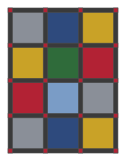
The quilt is a grid. Every block is the same size, and when there's sashing, there's a strip between every pair of blocks and around the outside, with a small cornerstone square wherever two strips cross.
| What | Formula | 12 shirts, 14 in blocks, 2 in sashing |
|---|---|---|
| Finished width | columns × block + (columns + 1) × sashing | 3 × 14 + 4 × 2 = 50 in |
| Finished length | rows × block + (rows + 1) × sashing | 4 × 14 + 5 × 2 = 66 in |
| Shirt block cut size | block + ½ in | 14½ in square |
| Interfacing squares | block + 1 in, one per block | 12 squares of 15 in = 180 in = 5 yd |
| Sashing pieces | columns × (rows + 1) + rows × (columns + 1) | 15 + 16 = 31 |
| Cornerstones | (columns + 1) × (rows + 1) | 4 × 5 = 20 |
| Binding | 2 × (width + length) + 10 in, in 2½ in strips | 242 in, 7 strips |
| Backing | quilt + 4 in on every side, in 40 in widths | 58 × 74 in, two 58 in lengths |
Strip yardage is the number of strips times the strip width, plus 2 inches to straighten the cut edge, rounded up to the next eighth or third of a yard. The sashing above is 16 strips × 2½ in + 2 in = 42 inches, so 1¼ yards. All width-of-fabric cuts assume 40 usable inches once the selvages are off. These are the same rules the T-shirt quilt pattern uses, so the calculator gives its 12, 20 and 30 shirt amounts exactly.
Picking a layout
Some shirt counts fit a grid neatly and some don't. Twelve shirts make 3 × 4 with nothing left over. Seventeen don't divide into anything useful. With 15-inch blocks and no sashing, 3 × 6 needs one extra block and makes a long, narrow quilt (45 × 90 inches), while 4 × 5 needs three extra blocks and gives 60 × 75. The calculator scores each grid on how many extra blocks it needs and how close it comes to the proportions of a bed, and it picks 4 × 5 here. If you'd rather have the narrow one, type 3 in "Blocks across."
Extra blocks are easy to fill:
- Four small chest logos, each cut 7½ inches square and sewn into a four-patch, make one 14½-inch block.
- A plain block of the sashing fabric with an embroidered name, a team, or the years the shirts cover.
- The back of a shirt that has a good print on both sides.
- A pocket or sleeve print set into a plain square.
Choosing the block size
Lay out the shirts and find the biggest print. Measure it, add at least half an inch of air on every side, and that's the smallest finished block that won't crop it. For most adult shirts, 14 inches works. Big back prints on XL shirts can need 16. Children's shirts often fit 12. Don't cut into a print to make it fit; make every block bigger instead. Two inches more per block adds 2 inches per block across and down, so a 3 × 4 quilt with 16-inch blocks finishes at 56 × 74.
Mixed sizes are possible (the "no-sashing puzzle" style), but the math is a layout drawing rather than a calculator, and a first T-shirt quilt is much easier with one size.
About the interfacing
Knit stretches; woven sashing doesn't. A woven fusible interfacing on the back of every shirt stops the seams from waving. Cut each square an inch bigger than the finished block (half an inch more than the trimmed block), fuse it, then trim the shirt and interfacing together. Enter the width of your interfacing: the calculator fits as many squares across it as it can. At 20 inches wide, only one 15-inch square fits across, so each shirt uses 15 inches of length. At 45 inches wide, three fit, and the yardage drops by about two-thirds.
Common mistakes
| Mistake | What happens | Fix |
|---|---|---|
| Trimming shirts before fusing | The knit curls and stretches; blocks come out uneven | Rough-cut, fuse, let cool, then trim to size |
| Block too small for one print | One shirt gets cropped or shrunk with a smaller grid | Size every block to the biggest print |
| Forgetting the outside sashing | The quilt comes out one sashing width short on each side, and the cornerstone count is off | Count sashing around the outside too, as the formulas above do |
| Buying backing for the top only | The longarm quilter sends it back | Add 4 inches on every side (some quilters ask for 5; check) |
Related pages
The full sewing steps are in the T-shirt quilt pattern. If the shirts belonged to someone you've lost, making a memory quilt from clothes covers which garments work and how to plan around them. For a quilt that isn't a grid of equal shirts, the how many blocks calculator fits any block size to a target size. Sending the top out to be quilted? The longarm cost calculator prices it, and some shops charge more for T-shirt quilts, so ask.
You might also like
 How many squares from a fat quarter? Fabric yield calculatorHow many pieces you can cut from a fat quarter, precut or yard, and how many to buy.
 Prairie points calculatorCut square size for any point height, how many points fill each edge, and the fabric to cut them from.
 Setting triangle calculator for on-point quiltsSide and corner triangle cuts, counts and finished size for blocks set on point.
 Hexagon template generatorTrue-size hexagon sheets for paper piecing, with a count and fabric calculator for rosettes and whole quilts.