Calculator
Turn on JavaScript to use the calculator, or use the formulas below.
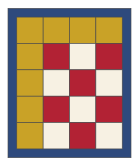
How the math works
Work out each direction on its own. Take the target, subtract the borders, then see how many blocks and sashing strips fit in what's left.
| Layout | Blocks across (before rounding) | Actual width |
|---|---|---|
| Blocks only | (width − 2 × border) ÷ block | n × block + 2 × border |
| Sashing between blocks | (width − 2 × border + sashing) ÷ (block + sashing) | n × block + (n − 1) × sashing + 2 × border |
| Sashing between and around | (width − 2 × border − sashing) ÷ (block + sashing) | n × block + (n + 1) × sashing + 2 × border |
Round to the nearest whole block, then put that back into the right-hand formula to get the real width. Do the same for the length. Total blocks = blocks across × blocks down.
A worked example: a queen mattress with a 12-inch drop wants a quilt 84 × 92 inches (60 + 12 + 12 wide, 80 + 12 long). With 12-inch blocks, 2-inch sashing all around and a 4-inch border, the width is (84 − 8 − 2) ÷ 14 = 5.3, so 5 blocks, and 5 × 12 + 6 × 2 + 8 = 80 inches. The length is (92 − 8 − 2) ÷ 14 = 5.9, so 6 blocks and 94 inches. That's 30 blocks for an 80 × 94 quilt: 4 inches narrower than planned, 2 inches longer. Widen the border by 2 inches and the width comes out at 84 and the length at 98.
Sashing pieces, when the sashing goes all around: across × (down + 1) + down × (across + 1), with (across + 1) × (down + 1) cornerstones. Between the blocks only: (across − 1) × down + (down − 1) × across pieces and (across − 1) × (down − 1) cornerstones. The calculator gives you both counts with their cut sizes.
Bed sizes and drop
The mattress sizes in the list are the standard US sizes (see, for example, Saatva's mattress size guide). Mattress depth varies a lot, so measure yours: the drop is the distance from the top edge of the mattress down to where you want the quilt to stop. To cover just the mattress, measure its side; to hide a box spring, measure to the bottom of the box spring; for a quilt that reaches the floor, measure to the floor. The calculator adds the drop to both sides and the foot, and adds a pillow tuck to the length if you want the quilt to fold under and over the pillows. Measure the tuck with a tape around your own pillows.
For a chart of standard quilt sizes, use StitchTested's quilt size chart; this page is for turning one of those sizes into a block count.
When the numbers don't come out even
They rarely do. Three ways to land on the size you want:
- Change the border. Every inch on the border adds 2 inches to the quilt in both directions. This is the easiest fix and the one most quilters use.
- Change the sashing. A quarter inch more sashing on a 6-block row with sashing all around adds 1¾ inches.
- Use a different count in one direction only. The "next size" table shows what one block more or fewer gives in each direction, so you can take the wider version and the shorter one if that suits the bed.
Changing the block size itself works too, but it changes every cut in the block. The quilt block resizer gives new cuts for common blocks when you do.
Mistakes to avoid
- Entering the unfinished block size. A block that measures 12½ inches with its seam allowance is a 12-inch block. The calculator wants 12.
- Counting a border once. A 4-inch border goes on both sides, so it adds 8 inches.
- Forgetting that quilting draws the quilt in. Dense quilting, and a cotton batting that shrinks in the first wash, both make it a little smaller than the top. If the size really matters, aim a little big.
- Setting blocks on point with this calculator. On point, each block takes its diagonal (block × 1.414) of space. Use the setting triangle calculator for that layout.
Related pages
Once you know the count, the guide to adding borders covers measuring and cutting the border strips, and StitchTested's fabric guide turns the top into yardage. Making a quilt to donate? The charity quilt size guide lists the sizes programs ask for, and you can enter any of them here.
You might also like
 How much thread do I need for a quilt?A rough estimate of piecing and quilting thread by quilt size and quilting density, with the formulas shown.
 Quilt block resizerThe full cutting list for seven classic blocks at any finished size.
 Rag quilt calculatorHow many squares and how much flannel a rag quilt takes at any size and seam allowance.
 Prairie points calculatorCut square size for any point height, how many points fill each edge, and the fabric to cut them from.