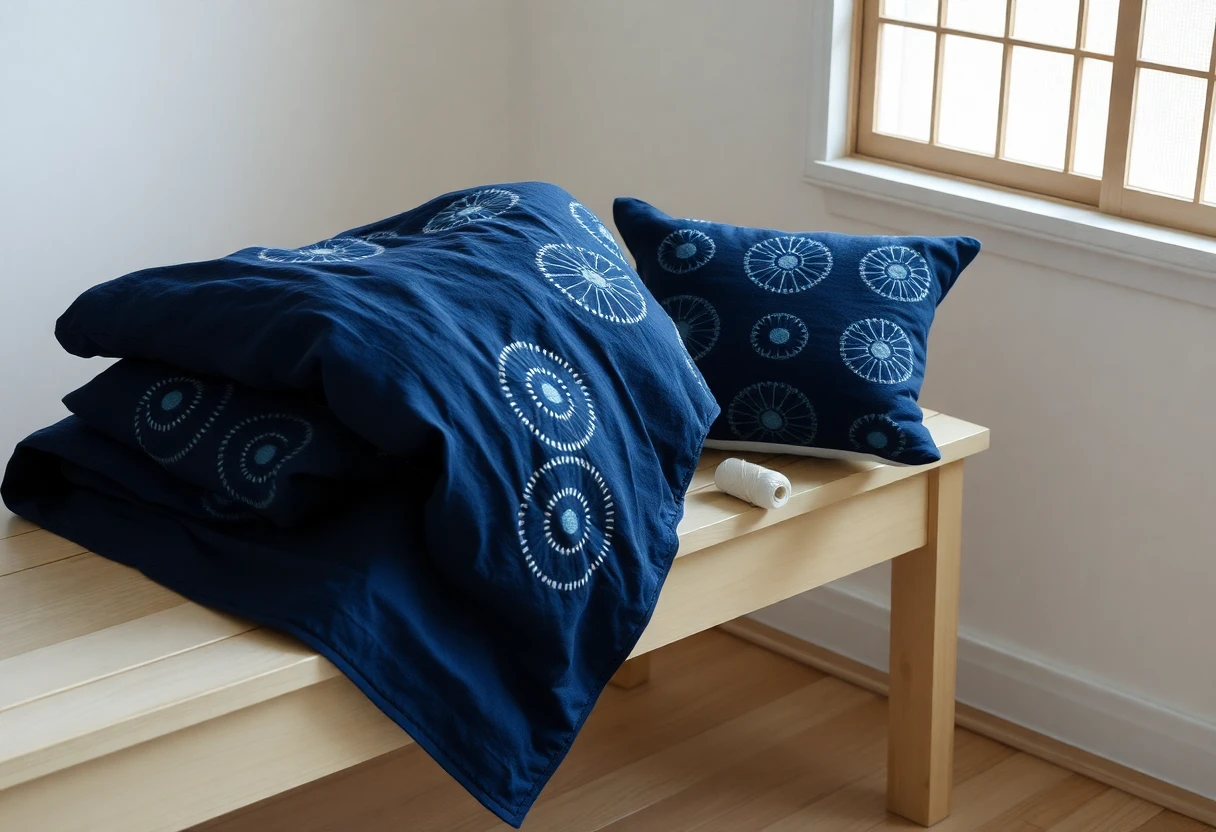
Where it comes from
The name comes from the verb sasu, to pierce or stab, and is often translated as “little stabs,” according to the Embroiderers' Guild of America. The guild places its origin in the Edo period (1603 to 1868), when women in farming and fishing communities stitched layers of cloth together to make clothing thicker, warmer and longer-lasting, and to mend it, because cloth was costly and hand-made. Hemp and, later, cotton were the cloth of ordinary people, and white thread on indigo became the familiar look.
Sashiko was also used for much heavier work. The Victoria and Albert Museum holds a firefighter's jacket made between 1850 and 1900 of several layers of indigo cotton quilted together with sashiko; the museum notes that the thick, stitched jacket soaked up water, and firefighters were drenched before going near a blaze. By the Meiji period (1868 to 1912), sashiko had become winter work in northern farming communities, when it was too cold to work outside, as the Wikipedia article on sashiko summarizes.
Two families of pattern grew from that work. In moyōzashi, long lines of running stitch form the design. In hitomezashi, single stitches lined up on a grid build denser patterns that can look woven.
Four patterns to start with
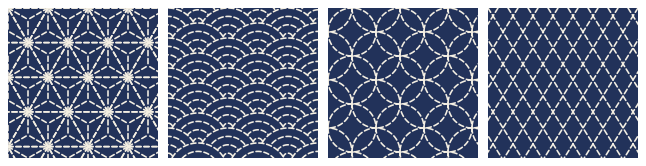
All four are moyōzashi patterns built on simple grids, which is why they suit quilters who already think in grids.
| Pattern | How to draw it | Difficulty |
|---|---|---|
| Hishi (diamonds) | Two sets of parallel diagonal lines, crossing | Easiest: straight lines only |
| Asanoha (hemp leaf) | A grid of equilateral triangles, plus a line from each triangle's three corners to its center. Six-pointed stars of leaves appear where the triangles meet. | Medium: many short lines and turns |
| Shippō (linked circles) | On a square grid, circles two squares in radius centered on every fourth grid point, then a second set centered in the gaps between them | Medium: curves, but only one circle size |
| Seigaiha (waves) | Rows of concentric half circles, each row offset by half a circle and stepped up by half a radius | Harder: nested curves that must stay evenly spaced |
The shippō layout follows the square-grid method described in a 2006 Bridges mathematical art paper. Shippō means “seven treasures.” Other traditional patterns you'll see named in books include kagome (woven bamboo), uroko (fish scales) and amime (fishing nets).
Materials
| Item | What to use |
|---|---|
| Thread | Sashiko thread: cotton, thicker than sewing thread, made of fine strands twisted together, and not split like embroidery floss. Size 8 perle cotton is a common substitute. |
| Needle | A long sashiko needle with a big eye, so you can load several stitches at once. A long darner works too. |
| Fabric | Medium-weight cotton with an even weave: indigo or another dark solid shows the white thread best. Quilting cotton works; tightly woven fabrics are harder to load. |
| Marking | White chalk pencil, a white gel pen that washes out, or a water-soluble marker on light fabric. Mark a ½-inch or 1-inch grid first. |
| Thimble | A thimble that fits on the palm, or a leather finger thimble, to push a long needle through several stitches |
How to stitch

- Prewash the fabric and the thread. Cotton sashiko thread can shrink, and a quilt that shrinks around unshrunk stitches puckers.
- Mark the grid, then the pattern lines on it. Stitch all the lines running in one direction first, then the next direction. On asanoha, stitch the long grid lines first and the short spokes last.
- Load several stitches on the needle before pulling it through, keeping the fabric smooth on the needle. Aim for stitches a little longer than the gaps between them, and keep them even; the rhythm matters more than the exact length. Five to seven stitches per inch is a comfortable range with sashiko thread.
- Stop a stitch short of every corner and start the next line just past it, so the corner reads as a clean point instead of a blob.
- Where two lines cross, don't let stitches cross each other. Leave a gap in one line so the other passes through it.
- At each turn on the back, leave a tiny loop of slack thread. Pulled tight, the thread draws the fabric up when the piece is washed.
- Smooth the stitched area between your fingers often, pushing along the thread, to spread the tension evenly.
Using sashiko on quilts
Quilters use it three ways.
Stitched blocks. Stitch a pattern on each indigo square first, then piece the squares into a sampler quilt with plain sashing. Stitch on a single layer, or with a thin layer of interfacing behind it, and leave a ¼-inch margin around the design for the seams. A 12½-inch block (12 inches finished) holds a 10-inch design comfortably.
Sashiko as the quilting. The stitch also works as hand quilting through all three layers. Use a thin, low-loft batting (cotton or a thin wool), because a puffy batting makes the long needle hard to load. Quilt the pattern across the whole quilt or in the borders. The look is close to what quilters call big-stitch quilting: thick thread, longer stitches, meant to be seen. For hand-quilting basics, see how to hand quilt.
Mending. Sashiko began as a way to strengthen and patch cloth, and it is still a good way to repair a worn family quilt: lay a patch of a similar fabric behind or over a worn area and stitch a simple grid or hishi pattern through it. The patch shows, and that's fine; it becomes part of the quilt's story. Our guide to washing quilts covers caring for an older quilt before and after.
Common problems
| Problem | Cause | Fix |
|---|---|---|
| Fabric puckers along the lines | Thread pulled tight, or no slack at turns | Smooth along each line after stitching; leave slack loops on the back |
| Uneven stitches | Loading one stitch at a time | Load four or five stitches, and keep the grid marks as guides |
| Corners look heavy | Stitching right into the corner point | Leave a gap at the corner on both lines |
| Thread frays and fuzzes | Working length too long | Use about an arm's length at a time |
| White marks won't wash out | Marker not tested | Test every marker on a scrap of the same fabric, washed, before you start |
For quilting motifs that use the machine instead, see echo and feather quilting. The grid-based patterns also suit a memory quilt made from denim and work shirts, where a heavy, visible stitch matches the fabric.
You might also like
 Bow tie quilt blockA four-patch with stitch-and-flip corners, cut for four sizes, and how to use neckties.
 How to label a quiltWhat to write on a quilt label, four ways to make one and how to sew it on.
 English paper piecingWrap fabric around paper shapes, baste with thread or glue, then stitch the edges together by hand.
 How to hand quiltBetweens, thread, hoop and thimble, then the rocking stitch and how to hide every knot.