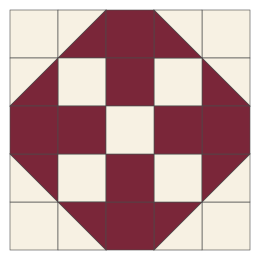
How the block is built
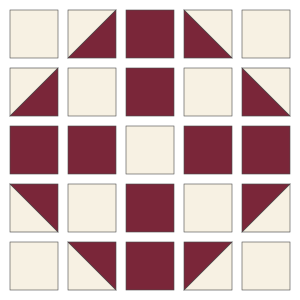
Every unit is a fifth of the block. Row by row, with B for background, P for print and T for a half-square triangle:
| Row | Units, left to right |
|---|---|
| 1 and 5 | B, T, P, T, B |
| 2 and 4 | T, B, P, B, T |
| 3 | P, P, B, P, P |
The triangles always sit next to a print square at the middle of an edge, with their print half touching that square and facing into the block. So in row 1, the left triangle has its print in its lower-right half and the right triangle in its lower-left half. In row 2 the outer triangles have their print on the side that touches the row 3 print squares. The middle 3 × 3 (rows 2 to 4, columns 2 to 4) is a plain nine-patch with background corners and center.
A sister's choice is sometimes made with plain squares in place of the triangles, which turns it into an all-squares block. Both versions are around; this page covers the triangle version.
Cutting chart (one block)
| Finished block | Unit | Background squares | Print squares | For the 8 HSTs (background + print) | Unfinished block |
|---|---|---|---|---|---|
| 7½ in | 1½ in | 9 squares 2 in | 8 squares 2 in | 4 + 4 squares 2⅜ in (or 2½ in to trim) | 8 in |
| 10 in | 2 in | 9 squares 2½ in | 8 squares 2½ in | 4 + 4 squares 2⅞ in (or 3 in to trim) | 10½ in |
| 12½ in | 2½ in | 9 squares 3 in | 8 squares 3 in | 4 + 4 squares 3⅜ in (or 3½ in to trim) | 13 in |
| 15 in | 3 in | 9 squares 3½ in | 8 squares 3½ in | 4 + 4 squares 3⅞ in (or 4 in to trim) | 15½ in |
Squares are the unit + ½ inch; HST squares are the unit + ⅞ inch (exact) or + 1 inch (to trim back to the unit + ½ inch). 9 + 8 + 8 = 25 units, one full five-patch. All sizes checked by calculation. The 10-inch block is the easy one: every plain square is 2½ inches, so a jelly roll or a stack of 2½-inch strips cuts it with no measuring beyond the strip.
Five-patch blocks fit sizes that divide by 5. For anything else (a 12-inch sister's choice, say) the unit is 2.4 inches, which isn't on a ruler; it's better to pick 12½ inches and adjust the setting. The block resizer explains why.
Piecing steps
- HSTs: draw a diagonal on the wrong side of the four background HST squares. Pair each with a print square, sew ¼ inch on both sides of the line and cut on it. Press toward the print and trim all eight to the unit + ½ inch.
- Lay out all 25 units using the row table. Turn each HST so its print half touches the print square at the middle of the nearest edge.
- Sew each row. Press rows 1, 3 and 5 to the left and rows 2 and 4 to the right, so every seam nests with the row above and below.
- Join rows 1 and 2, then 4 and 5, then add row 3 between the two halves. Pin at every seam intersection; there are four per row.
- Press the row seams in one direction, or open if the block will be heavily quilted.
- Measure: 8, 10½, 13 or 15½ inches.
Twenty-five units is a lot to keep straight. Lay the block out on a small board or a piece of batting next to the machine, take each row off to sew it and put it back before starting the next.
Choosing fabrics
Two fabrics with strong contrast are the traditional choice and the clearest. A third fabric works well in the nine-patch center only (the four print squares around the middle), which makes the block look like a cross with a contrasting heart. For a scrappy quilt, make each block in a single print and keep one background throughout, as in the quilt diagram below. Medium-value backgrounds tend to swallow the triangle points.
Common mistakes and fixes
- A triangle points the wrong way. The print half must touch the print square at the middle of the edge. Lay out the whole block before sewing any row.
- Rows don't match in length. Five seams per row multiply any seam error by five. Check one finished row against the expected length (the block's unfinished size) before sewing the rest.
- Points cut off at the block edge. The HSTs were trimmed off center. Put the ruler's 45-degree line on the seam when trimming.
- Seams fight at intersections. All rows pressed the same way. Alternate the pressing direction row by row.
Quilts made from sister's choice
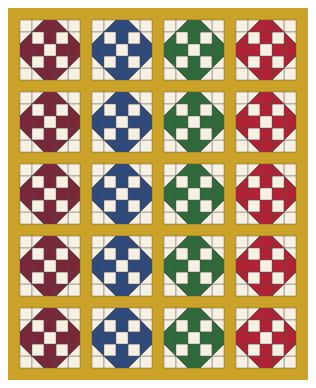
With sashing the blocks read as separate crosses. Set side by side, the background corners of four blocks meet in a larger square and the crosses link into a grid. The name makes it an obvious pick for sisters or a family reunion: each person makes a block in their own color. Put everyone's name on the label.
Related blocks
For another block built row by row from squares and triangles, see the churn dash or shoofly. The double Irish chain is another five-patch, and the bear's paw moves up to seven. HST sizes for any unit are on the half-square triangle calculator; the quilt block library has every block on the site.
You might also like
 Jacob's ladder quilt blockFive four-patches and four triangle squares that link into diagonal ladders, cut for 6, 9 and 12 inch blocks.
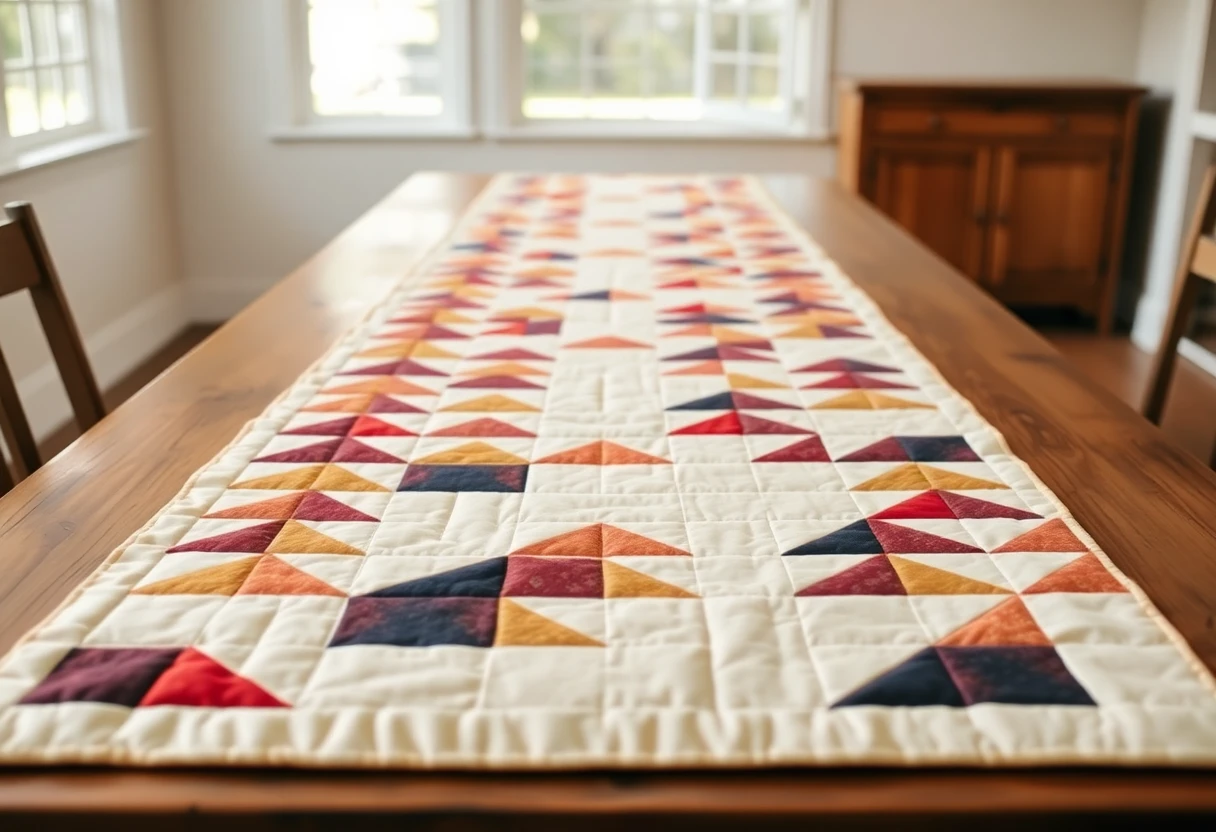 Flying geese quilt blockStitch-and-flip and no-waste geese, cut charts for five sizes and how to keep the points.
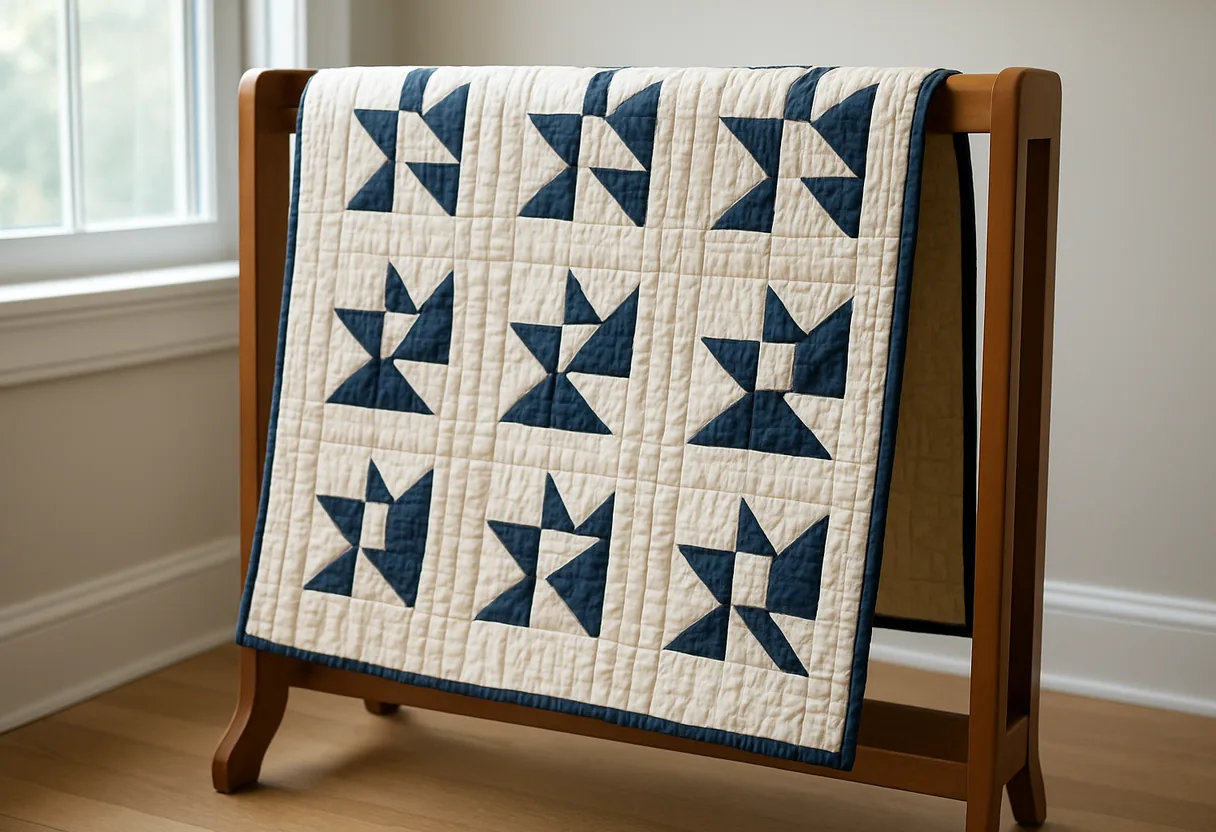 Friendship star quilt blockA nine-patch star of four half-square triangles, with a plain center for signatures.
 Shoofly quilt blockA nine-patch with half-square triangle corners, cut for 6, 9 and 12 inch blocks.