On September 9, 2005, the Daily American of Somerset, Pennsylvania ran a story by staff writer Vicki Rock headlined “Woman inspired to quilt by Sept. 11 events.” Its subject was Kathie Baumgardner, who organized the 9-11 Memorial Quilt Project, and the quilt she had made for Pennsylvania. Flight 93 had come down in the paper’s home county. The story appeared two days before the fourth anniversary of the crash, in the same week the permanent memorial’s design was chosen.
What the story said
Rock began with Baumgardner’s decision, two days after the attacks, to lead a quilt project. She was living in Tuscumbia, Alabama, by then, but she was originally from Johnstown, about 18 miles from the crash site. She told the paper she had finished quilts that a girl had started after the Columbine shooting, and had hoped there would never be another tragedy to memorialize. On September 13, 2001, she felt led to make a quilt anyway.
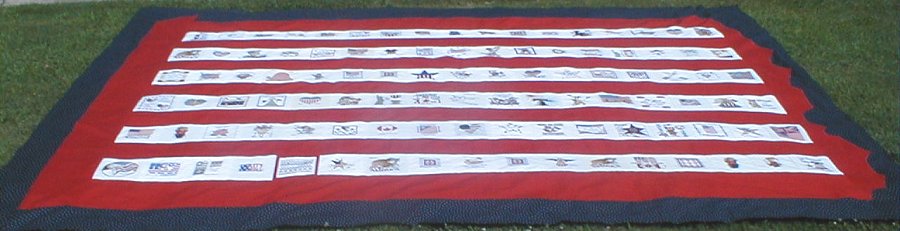
The story quoted the project’s motto, “With Needle and Thread, Precious Lives We Hope to Mend,” and described the Pennsylvania quilt closely: a blue background with stars and a large red Keystone shape holding 102 squares, each one cross-stitched by hand. The paper’s photo shows Baumgardner holding the quilt up in front of the Flight 93 Temporary Memorial, where she had brought it.
The first page ended with the size of the whole effort. There were five quilts, one each for the World Trade Center, the Pentagon, Pennsylvania, the New York fire department and the New York police department. 375 stitchers in 47 states and 14 countries made 524 squares, and the work took three years.
The square at Somerset County
The paper reported that the square at Somerset County’s position on the map reads “Let’s Roll!” with stars on a blue field. The square itself bears that out. It reads “Remembering September 11th” and “Honoring all the heroes of United Flight 93,” ending with “Let’s Roll” in quotation marks, between bands of stars, small flags and hearts. It is Baumgardner’s own work. The signature line names her as quilt coordinator, in Florida at the time and “formerly from Johnstown, PA.”

Her notes from July 2004 add two things the paper left out. The square is outlined in red fabric to show where Flight 93 went down, and a second square stitched with “Let’s Roll” sits right next to it. She chose the blue fabric with tiny stars because, to her, it meant that the people lost there rest under a field of stars. “Let’s roll” were the words reported from the plane as passengers rushed the hijackers. For the full construction diary, see how the quilts were made.
Who stitched the Pennsylvania quilt
The paper counted 102 squares, and the project’s stitcher list agrees. That list also shows something the story didn’t have room for: this Pennsylvania quilt was mostly made elsewhere. Only 12 of the 102 squares came from Pennsylvania stitchers, about one in eight. Another 63 came from 29 other states, from Hawaii to New Hampshire, with Kansas (6) and Texas (5) sending the most. The remaining 27 crossed a border or an ocean: Canada 15, Australia 6, England 2, and one each from Scotland, France, the Netherlands and Italy.
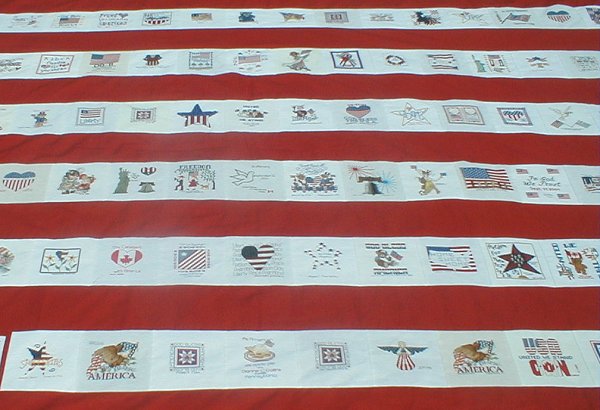
In all, 89 people worked on it. Most sent one square, and Sally Swaine of Canada sent the most, with five. Baumgardner’s notes say the Pennsylvania squares were placed on the map by the stitcher’s city; they don’t say how the other 90 were arranged. The eleven stitchers the list gives as Pennsylvanian are Denise Allwine, Michele Bellis, Dianne Collins, Beverly Fry, Donna Hoppes, Carol Lauffer, Deanna Lengyel, Melissa Miller, Joni Mowery (two squares), Sandy Neidig and C. Spaniol. Every name on all five quilts is in the list by quilt.
These photos were posted on the project’s own site and recovered from the Internet Archive. Every effort is being made to preserve the historic significance of this project, though we will respect credible requests to remove a photo. Contact us.
From quilt top to the memorial
The quilt in Rock’s photo was the last of the five to come together. Baumgardner finished the other four first and had to wait for extra fabric before she could complete this one. The top was done on July 21, 2004. On August 3 she took it to Beverly Marshall, a friend in Alabama and a cross-stitcher herself, who did the quilting at no charge. Finished, it measured 8 by 10 feet, far squarer than the 7 1/2 by 14 foot World Trade Center and Pentagon quilts.
About thirteen months after that drop-off, she carried it to the county it had been made for. The old site records only this quilt going to Somerset County. All five were shown together at the needlework show in Hershey later that month.
The temporary memorial in the photo
The place in Rock’s photo was not yet a monument. Officials set up the temporary memorial in early October 2001 on a hilltop overlooking the crash site, with a parking area and a section of fence where visitors could attach tributes. The National Park Service calls that fence an ever-changing collage. An Associated Press report from August 2004 put the site about 500 yards from the crash site, at the end of dusty Skyline Road, past a junkyard and two rusting mining draglines.
The fence was 40 feet long. That same report described hats, flowers and rosaries fastened to it, crosses and stuffed animals on the ground, and messages written in ink on the guardrails by the parking lot. Local volunteers known as ambassadors had staffed the site since January 2002 and answered visitors’ questions. The county’s historical society cataloged what people left, and the Park Service later said the tributes were being archived for future exhibits and study. Crowds were still large four years on: the memorial’s curator put 2005 visitation at 130,000.
The same week, a design for the permanent memorial
On Wednesday, September 7, 2005, two days before the story ran, the Flight 93 Advisory Commission chose the design called “Crescent of Embrace,” from a team led by Paul Murdoch Architects of Los Angeles. It was picked from five finalists, out of about 1,100 entries in an international competition. More than 50 friends and relatives of the passengers and crew were there, and they gave it a standing ovation.
News reports described a 2,000-acre park with a crescent of maple trees around the crash site, the names on a white marble wall, and 40 wind chimes, one for each person who died. The chimes eventually became part of the 93-foot Tower of Voices. The surviving page of the Daily American story doesn’t mention the design, but it shows what the place still was that week: a fence on a hill, with a handmade quilt held up in front of it.
A county used to visitors
By 2005 Somerset County had spent four years receiving strangers. In 2004 the chairman of the county commissioners estimated as many as 5,000 visitors a week at the site, and he told the Associated Press he preferred to call them pilgrims. Many made a day of it. They might stop at the site of the Quecreek Mine accident, where nine trapped miners were freed after 77 hours in July 2002, or at the Thunder on the Mountain chapel, a century-old seed warehouse renovated in the year after the crash. Residents and family members had pressed to keep the area around the memorial free of souvenir shops and food stands.
The Daily American was the local daily through all of this. The paper began on July 1, 1929 as the Somerset Daily Herald, the town’s first daily, and stayed in the founding family until it was sold to Schurz Communications in 1997. It was still printed on its own press in Somerset in 2005, and would be until 2013.
The anniversary notice beside it
Next to the story, the paper printed the plan for that year’s ceremony at the temporary memorial in Stonycreek Township: 9:30 to 10:30 a.m. on September 11, with the reading of the passengers’ and crew’s names, the tolling of bells, music and short remarks. Access was from Lambertsville Road only, not Buckstown Road, because the Route 31 bridge before Technology Center Road was closed. Shuttles ran from a parking lot on Skyline Road to the ceremony tent from 8 a.m. until 9:15 a.m., with none during the ceremony.
It is a small record of how the site worked before the permanent memorial opened. That Sunday, Attorney General Alberto Gonzales laid a wreath at the temporary memorial, according to an Associated Press photo caption.
What became of that spot
The temporary memorial didn’t stay where the paper photographed it. By July 2010, construction had forced another move, this time to what is now the Western Overlook, once a coal company complex and the command center for the FBI’s investigation. On the evening of September 9, 2011, six years to the day after this story’s date, the flag came down over the temporary memorial for the last time. The first features of the permanent memorial were dedicated the next morning.
Visitors can still walk to the original location. The half-mile Trail of Remembrance, which the Park Service began building in 2019, follows part of the old Skyline Road from the Memorial Plaza area to where the temporary memorial stood. A selection of the tributes left over the years is on display in the Visitor Center.
Where the quilt was meant to go
Baumgardner didn’t make the quilts to keep. The old front page says she was exhibiting them before they took up permanent residence in their respective areas, with one meant for the Somerset County memorial. As she put it there, they would otherwise only be sitting in storage until the memorials were built. So the quilts traveled. She brought the project to New York for the fifth anniversary in 2006, at the invitation of the founder of Voices of September 11th, and stopped in Shanksville on the way home. The last showing of the quilts we can document was a needlework exhibit in Williamstown, Pennsylvania on June 18, 2011, less than three months before the first permanent features of the memorial were dedicated.
We have found no public record of where the Pennsylvania quilt is now, or whether it reached the memorial. The Park Service says its tribute collection holds about 50,000 items, that it stopped adding tributes in October 2021, and that it still has a significant backlog to catalog. Its museum staff also care for objects given by family and friends of the passengers and crew, and more than 800 oral history interviews. None of that tells us the quilt is there. If you know where it went, we would like to hear from you.
What survives
The old project site showed the article as two scanned clippings. The first page ends with “See QUILT on Page 3,” and we have found no copy of the second scan, so the rest of the story is lost to us. The story isn’t on the Daily American’s own website, so the source today is the old project page, saved by the Internet Archive in 2006. We don’t republish the clipping; the summary above is in our own words. Click the placeholder to open the archived page in a new window.

Looking for the rest of the story
A citation for anyone searching: Vicki Rock, “Woman inspired to quilt by Sept. 11 events,” Daily American (Somerset, Pa.), September 9, 2005. That date comes from the old project site. The clipping itself shows no date, so a search should take in the days around it. The story continues on page 3 under the word QUILT. The paper’s own office is the first place to ask, and the research library at the Somerset Historical Center, which collects archival material on the county, is the next. We haven’t confirmed that either one holds this issue.
If you have a clean copy of the full clipping, especially the continuation on page 3, please send it.
The Johnstown paper covered the project the day before; see why that story mattered in Johnstown. For the rest of the 2005 trip, including the presentation to Flight 93 families at the Somerset County courthouse, see Pennsylvania, 2005. See all coverage.
Sources: Vicki Rock, Daily American, September 9, 2005; the project’s own construction notes, updates and front page; the project’s stitcher list; National Park Service, the memorial process and a 2019 memorial update and the Trail of Remembrance and tributes; Somerset Historical Center; Associated Press, “Tributes recall heroes of Flight 93,” 2004; NBC News on the design choice, 2005; Herald-Standard, 2006; CBS News fourth-anniversary photos; Wikipedia on the Daily American.